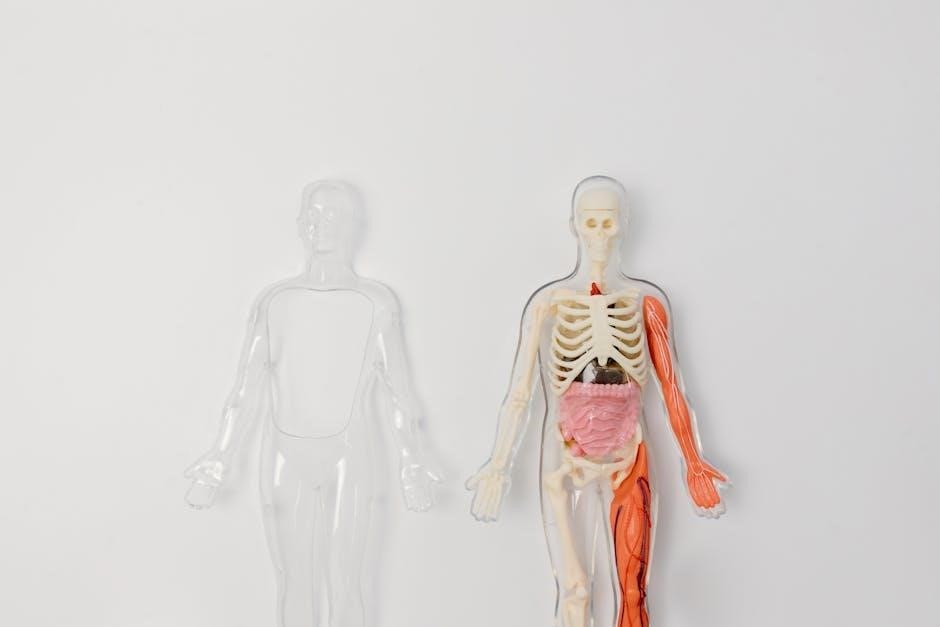
Human bodies exhibit remarkable complexity, comprised of eleven interconnected systems working in harmony to sustain life and perform essential functions.
Overview of System Interdependence
Human body systems aren’t isolated entities; they demonstrate profound interdependence, constantly communicating and collaborating to maintain overall well-being. For instance, the cardiovascular system delivers oxygen obtained by the respiratory system, fueling muscular contractions coordinated by the nervous system.
Digestive processes provide nutrients utilized by all systems, while waste products are eliminated via the urinary system. This intricate network highlights how a disruption in one system can cascade, impacting others and emphasizing the body’s holistic nature.
The Importance of Homeostasis
Homeostasis, the body’s ability to maintain a stable internal environment, is paramount for survival and optimal function. This dynamic equilibrium requires constant adjustments across all systems, responding to both internal and external changes.
Temperature regulation, blood pH, and glucose levels are meticulously controlled. Disruptions to homeostasis, even minor ones, can lead to illness, demonstrating the critical role of coordinated system activity in preserving health and ensuring cellular functions proceed efficiently.

Cardiovascular System
The cardiovascular system, powered by the heart, distributes oxygen, nutrients, and hormones throughout the body, enabling vital organ function.
Heart Structure and Function
The heart, the central organ of the cardiovascular system, is a muscular pump responsible for circulating blood throughout the body. Its structure includes four chambers – two atria and two ventricles – working in coordinated contractions.
These contractions propel blood to the lungs for oxygenation and then to the rest of the body, delivering essential nutrients and removing waste products. Valves ensure unidirectional blood flow, preventing backflow and maintaining efficient circulation, crucial for overall function.
Blood Vessels: Arteries, Veins, and Capillaries
Blood vessels form a network distributing blood throughout the body. Arteries carry oxygenated blood away from the heart, possessing thick, elastic walls to withstand pressure. Veins return deoxygenated blood to the heart, featuring thinner walls and valves to prevent backflow.
Capillaries, the smallest vessels, facilitate nutrient and waste exchange with tissues. This intricate system, powered by the heart, ensures organs receive vital supplies for optimal function.

Digestive System
This system breaks down food into absorbable nutrients, utilizing the stomach and intestines for processing and extracting essential components for body sustenance.
Organs of the Digestive Tract
The digestive tract is a complex series of organs working collaboratively to process food. It begins with the mouth, where mechanical and chemical digestion starts, followed by the esophagus transporting food to the stomach. The stomach further breaks down food, then it moves to the small intestine for nutrient absorption.
Subsequently, the large intestine absorbs water and forms waste, which is then eliminated through the rectum and anus. Accessory organs like the liver, pancreas, and gallbladder contribute vital digestive juices and enzymes, ensuring efficient breakdown and absorption of nutrients throughout this intricate pathway.
Nutrient Absorption and Waste Elimination
Following digestion, the small intestine’s villi and microvilli maximize nutrient absorption into the bloodstream, delivering essential compounds to body cells. Water-soluble nutrients directly enter circulation, while fats are processed via the lymphatic system.
Undigested material progresses to the large intestine, where water is reabsorbed, and waste is compacted. This waste, including fiber and bacteria, is then eliminated from the body through defecation, completing the digestive process and maintaining internal balance.

Endocrine System
Hormones, produced by glands, regulate diverse bodily functions—growth, metabolism, reproduction—via chemical messengers traveling through the bloodstream, ensuring systemic coordination.
Hormone Production and Regulation
Hormone synthesis occurs within specialized endocrine glands, responding to internal and external cues; production is tightly controlled through feedback loops—positive or negative—maintaining hormonal balance.
These loops involve the brain (hypothalamus and pituitary gland) orchestrating hormone release, ensuring appropriate responses to physiological demands and maintaining overall body homeostasis.
Disruptions can lead to various disorders, highlighting the critical role of precise hormonal regulation in overall health and well-being across all systems.
Glands and Their Specific Functions
The pituitary gland regulates growth, while the thyroid controls metabolism; adrenal glands manage stress responses via cortisol and adrenaline, impacting numerous body systems.
Pancreatic islets produce insulin and glucagon, regulating blood sugar levels, and the ovaries/testes generate sex hormones influencing reproductive development and function.
These glands, alongside others, secrete hormones directly into the bloodstream, orchestrating diverse physiological processes essential for maintaining internal stability and overall health.

Nervous System
The nervous system, encompassing the brain, spinal cord, and nerves, facilitates rapid communication and control, enabling sensory perception and coordinated responses.
Brain, Spinal Cord, and Peripheral Nerves
The brain serves as the central command, processing information and directing responses, while the spinal cord acts as a crucial communication pathway. Peripheral nerves extend throughout the body, transmitting signals between the central nervous system and limbs/organs. This intricate network enables sensory input, motor control, and reflexive actions, ensuring coordinated bodily functions. These components work seamlessly to maintain homeostasis and respond to internal and external stimuli, demonstrating the system’s vital role in overall human physiology.
Signal Transmission and Sensory Perception
Nervous system communication relies on electrochemical signals traveling along neurons, enabling rapid responses. Sensory receptors detect stimuli – light, sound, touch, taste, and smell – converting them into nerve impulses. These impulses are then relayed to the brain for interpretation, creating our perception of the world. This intricate process allows for awareness, learning, and adaptive behaviors, showcasing the system’s crucial role in interacting with the environment and maintaining human survival.

Respiratory System
This system facilitates gas exchange within the lungs, delivering oxygen to the body and removing carbon dioxide—a vital process for cellular function.
Lungs and Gas Exchange
The lungs are the primary organs of the respiratory system, responsible for the crucial process of gas exchange. Oxygen inhaled is transferred to the bloodstream, while carbon dioxide, a waste product of cellular metabolism, moves from the blood into the lungs to be exhaled. This exchange occurs within tiny air sacs called alveoli, surrounded by capillaries. Efficient gas exchange is fundamental for sustaining life, providing cells with the oxygen needed for energy production and removing harmful waste. The intricate structure of the lungs maximizes the surface area available for this vital function, ensuring adequate oxygen delivery throughout the body.
Breathing Mechanics and Oxygen Transport
Breathing, or ventilation, involves the mechanical process of inhaling and exhaling, driven by the diaphragm and intercostal muscles. Oxygen, once in the lungs, binds to hemoglobin within red blood cells for efficient transport throughout the body via the cardiovascular system. This oxygen-rich blood delivers vital oxygen to tissues and organs, supporting cellular respiration. Simultaneously, carbon dioxide is carried back to the lungs for removal, maintaining internal balance and enabling continuous bodily functions.

Integumentary System
Skin, hair, and nails provide crucial protective barriers against external threats, regulate body temperature, and house sensory receptors for environmental awareness.
Skin, Hair, and Nails: Protective Functions
The integumentary system’s primary role involves shielding the body from pathogens, UV radiation, and physical trauma. Skin acts as a waterproof barrier, preventing dehydration and infection. Hair offers insulation and protection, while nails safeguard sensitive fingertips and toes. Sensory receptors within the skin detect pain, pressure, and temperature, alerting the body to potential dangers and contributing to overall homeostasis. These structures collectively ensure survival and maintain internal stability.
Temperature Regulation and Sensory Receptors
The integumentary system actively regulates body temperature through sweat glands and blood vessel dilation/constriction. Sensory receptors within the skin detect stimuli like touch, pressure, pain, and temperature changes. These receptors transmit signals to the nervous system, enabling responses to external environments. This intricate interplay maintains a stable internal temperature, crucial for optimal cellular function and overall physiological balance, ensuring survival.
Skeletal System
Bones provide structural support, protect vital organs, and enable movement via joints. This system also facilitates blood cell production within bone marrow.
Bone Structure and Support
Bones aren’t simply solid masses; they possess a complex internal architecture providing incredible strength with minimal weight. Compact bone forms the hard outer layer, while spongy bone, filled with spaces, offers flexibility.
The skeletal system’s primary role is providing a rigid framework supporting the body against gravity. Bones also protect delicate internal organs, like the brain within the skull and lungs within the ribcage. Furthermore, bones serve as attachment points for muscles, enabling locomotion and maintaining posture.
Joints and Movement
Joints are crucial connections where bones meet, enabling a wide range of movements. These articulations are categorized structurally – fibrous, cartilaginous, and synovial – and functionally, based on their range of motion.
Synovial joints, like the knee and elbow, are highly mobile, featuring a joint cavity filled with lubricating fluid. Ligaments connect bone to bone, providing stability, while tendons attach muscle to bone, facilitating movement. The interplay between bones, joints, and muscles allows for coordinated locomotion and physical activity.

Muscular System
Muscle tissues—skeletal, smooth, and cardiac—facilitate movement, maintain posture, and generate heat, enabling essential bodily functions and overall physical activity;
Types of Muscle Tissue
The muscular system showcases three distinct tissue types: skeletal, smooth, and cardiac. Skeletal muscle, attached to bones, enables voluntary movements. Smooth muscle, found in organ walls, controls involuntary actions like digestion. Cardiac muscle, exclusive to the heart, powers continuous, rhythmic contractions.
Each type possesses unique structural and functional characteristics, contributing to the body’s diverse range of movements and physiological processes, ensuring coordinated and efficient bodily functions.
Muscle Contraction and Locomotion
Muscle contraction, driven by interactions between actin and myosin filaments, is fundamental to locomotion and movement. Nerve impulses trigger this process, causing filaments to slide past each other, shortening the muscle fiber.
This coordinated action, powered by energy from ATP, enables a wide spectrum of movements, from walking and running to intricate actions, facilitating interaction with the environment and maintaining bodily functions.
Lymphatic System
The lymphatic system defends against disease, maintains fluid balance, and absorbs fats, utilizing lymph nodes and vessels for crucial immune functions.
Lymph Nodes and Immune Function
Lymph nodes, strategically positioned throughout the body, act as filters, housing white blood cells – key players in the immune response. These nodes trap pathogens, initiating immune reactions to combat infections and diseases. They are vital for recognizing foreign invaders, triggering lymphocyte production, and maintaining immunological surveillance.
Effective immune function relies heavily on the lymphatic system’s ability to transport immune cells and facilitate their interaction with antigens, ensuring robust defense mechanisms.
Fluid Balance and Waste Removal
The lymphatic system plays a crucial role in maintaining fluid homeostasis by collecting excess interstitial fluid, returning it to the bloodstream, and preventing edema. Simultaneously, it aids in waste removal, transporting cellular debris and metabolic byproducts away from tissues.
This dual function is essential for optimal cellular environment and overall bodily health, contributing to efficient nutrient delivery and toxin elimination.
Urinary System
Kidneys filter blood, removing waste and excess fluids, maintaining electrolyte balance, and producing urine for excretion – vital for homeostasis.
Kidneys and Waste Filtration
The kidneys are paramount in maintaining internal stability through meticulous waste filtration. Blood enters, and nephrons – functional units – remove metabolic byproducts like urea and creatinine. Essential substances are reabsorbed, returning to circulation, while waste forms urine. This process regulates blood pressure, electrolyte balance, and red blood cell production. Efficient filtration is crucial for overall bodily health, preventing toxin buildup and ensuring proper fluid balance, demonstrating the urinary system’s vital role.
Fluid and Electrolyte Balance
Maintaining precise fluid and electrolyte levels is critical for cellular function, and the urinary system plays a central role. Kidneys regulate water reabsorption, responding to hormonal signals like ADH. Electrolytes – sodium, potassium, chloride – are carefully balanced, impacting nerve impulses and muscle contractions. Disruptions can lead to dehydration, edema, or dangerous imbalances, highlighting the urinary system’s essential contribution to homeostasis and overall physiological stability.
Reproductive System
Male and female reproductive organs facilitate gamete production, enabling species propagation through hormonal control and ensuring the continuation of life itself.
Male and Female Reproductive Organs
Male anatomy includes testes for sperm production, the prostate gland contributing fluid, and structures for delivery. Female organs encompass ovaries releasing eggs, the uterus for gestation, and the vagina facilitating birth. Both systems rely on intricate hormonal signaling. These organs work collaboratively to enable reproduction, ensuring species survival through gamete creation, fertilization, and fetal development. Proper function is vital for individual and population health, involving complex physiological processes and delicate balance.
Hormonal Control and Gamete Production
Hormones, chemical messengers, orchestrate reproductive processes, regulating gamete development and sexual characteristics. In males, testosterone drives sperm production. Females experience cyclical hormonal changes controlling egg release and uterine preparation. The hypothalamus and pituitary gland govern these processes. Gamete production—spermatogenesis and oogenesis—requires precise hormonal balance. Disruptions can lead to infertility or developmental issues, highlighting the system’s sensitivity and crucial role in maintaining reproductive health.